Tuesday, November 13, 2012

A Pioneer


Shown in his TQ Midget more than 50 years ago is Norm Smizer, one of the founding fathers of the ATQMRA and the organization’s first president. We are posting this picture this week because Smizer will be remembered at the ATQMRA banquet this Sunday, November 18.

At the banquet the Vintage Club will be presenting the Norm Smizer Preservation Award. The award will be presented to an individual who by his efforts and actions exemplified the Vintage Club’s goals of documenting, preserving, and displaying the history of TQ Midget racing. The award is named in memory of Norm Smizer in recognition of Smizer’s dedication, his craftsmanship, and his inspiring personal story.

In addition to being a driver, Smizer was a skilled craftsman and a talented engine builder. When he was no longer driving, he built engines for others, including four-time ATQMRA champion Doug Craig. But it is nothing short of inspirational to realize that the greatest of Smizer’s achievements as a engine builder came following the loss of his eyesight due to complications from cataract surgery in 1967. Terming his blindness as no more than "an inconvenience," Smizer continuing building engines – engines which won countless races and numerous championships.

But Norm Smizer will not be the only ATQMRA pioneer whom we recall at the banquet. The Vintage Club will also be presenting the Dick Marlow Participation Award, named in memory of the founder of Pine Brook Stadium and the ATQMRA’s first full-time traveling announcer. This award will be presented to teams who demonstrated outstanding participation and support of Vintage Club events during 2012.

Two additional awards are named in honor of individuals who are still very much with us. The Jim English Sportsmanship Award, named in honor of one of the finest gentlemen you’ll meet, will be presented to an individual who exemplifies amiability, a spirit of camaraderie and a positive attitude towards the Vintage Club and it's members.

The Robert Noll Service Appreciation Award is named in honor of auto racing's most dignified and dedicated supporter, and it will be presented to an individual whose efforts exceeded expectations for the betterment of the Vintage Club.

The banquet is this Sunday, November 18.

Wednesday, November 7, 2012

The Smith Crosley


This car should be considered to be the first vintage TQ.

It’s not the oldest car, but to our knowledge it is the first ATQMRA car to be restored following its retirement from active competition. It has appeared in the restored condition shown in this photo for well over 20 years.

The "Smith Crosley," as lettered on the hood, was campaigned by New Jersey-based owner Charlie Smith, with a variety of top drivers at the wheel through the years. It raced, and won, both with a roll bar as seen here, and with a roll cage fitted when cages became mandatory.

When it was retired from the track it was acquired by Pennsylvanian Jay Young, who restored it to the configuration shown and who still owns the car today. Young has participated with the car in Vintage Club events, but long prior to the formation of the Vintage Club in 2011 Young displayed the car as part of many vintage racing activities.

Back when the annual midwinter "Motorsports" show was still being conducted at the Valley Forge Convention Center, prior to outgrowing that facility, this restored car was part of a "then and now" display in the ATQMRA booth – that’s how long this car has been a restored classic.

Friday, November 2, 2012

Fort Dix


We are finally back with a new old photo, delayed due to the effects of Hurricane Sandy.

This photo is from a race track not far from the hard-hit areas along the Jersey shore: Fort Dix Speedway, which today is a dirt track named New Egypt Speedway but which was a paved track when this photo was taken in the late 1960s. The track is on Route 539 in Ocean County, not quite 20 miles inland from the storm’s oceanfront devastation.

In the photo are Bobby Courtwright, in the Ted Seiz Crosley #56, and Ben Trimble, in the Jon Fick Triumph #11. The shot is turn one at Fort Dix, on the original – and very abrasive – paved surface before the track was re-paved and enlarged in the early 1970s.

Bobby Courtwright has been gone for many years now, but Ben Trimble is alive and well at age 85, and is an active participant with the Vintage Club, as is the #11.

Wednesday, October 24, 2012

Greece is the Word!

TQVintage.com is viewed around the world and as a result we have received this photograph of a vintage TQ Midget... in Greece!


Constantin Sourelis of Evnia Automobiles, a collector-car broker in Switzerland, contacted us regarding a 1960 TQ that he is offering for sale on behalf of a client in Greece.

The car is fully restored and appears beautiful in all details, but in our view is optimistically priced at €24,000 (24,000 Euros). At the moment that this is written, the Euro-to-Dollar conversion makes that $31,500. Plus shipping. Yikes.  Update 1/18/13:  The seller has revised the price to a much more realistic and attractive US$16,000, including shipping to the US!

The car was built in 1960 in Florida by a racer named J.W. Payne, and was raced at the Florida City Speedway near Homestead, as well as at tracks in or near Jacksonville, Hialeah, and Palm Beach through at least 1966. After passing through several owners and suffering several periods of neglect, the car was given a high-dollar restoration in 1996.

It was not an ATQMRA-legal car, it ran on an alcohol-nitro mix with twin Dellorto carburetors and has a number of details that were perfectly legal in Florida TQ racing but which did not conform to ATQMRA rules. Not that we care today – all vintage TQs are welcome in the Vintage Club.

It is not clear how the car came to be in Greece, but Greece is where it is.

The sale of the car includes extensive documentation in two large files, with period photographs and even home movie footage – which can be seen here on Youtube. The photo below of J.W. Payne winning a race shows a sister car, Payne built three cars in all.


The car can be seen on the Evnia Automobiles web site, just scroll down a bit past the Bentleys and the Jaguars to find the TQ.

Wednesday, October 17, 2012

Camden Cop

One of the top drivers in the ATQMRA in the early 1960s was George Sweeten, shown here in his signature number 54. He raced at Teaneck, Pine Brook, Old Bridge, Wall Stadium and elsewhere in those years.

But despite being the club’s 1965 driver co-champion and winning one of the big indoor races in Atlantic City in 1966, he quit racing because his family perceived it as being too dangerous.

Sweeten then took up something hardly without risk: He became a cop in Camden. In case you are not familiar with the city of Camden, New Jersey, there are few places tougher for police work.

He joined the Camden Police Department in 1969. Already in his 30s when most police rookies were in their 20s, Sweeten was nicknamed "Pappy" by his fellow officers. He served Camden for 25 years before retiring in 1994, having risen to the rank of Detective.

George Sweeten passed away in December, 2007, at the age of 74.

Sweeten was remembered by a former police partner as "a good guy to work with, straight as an arrow so you didn't have to worry about him. He was an honest cop, an all-around good guy." Those who were around the ATQMRA when Sweeten was racing will also describe him as an all-around good guy. He conducted himself like a gentleman and was an easy fan favorite.

When George Sweeten set racing aside he was not without a hobby. He had worked as a sign painter and was an accomplished artist, painting landscapes and covered bridges. He was a devoted family man who left a widow, three daughters and five grandchildren at the time of his passing.

Tuesday, October 9, 2012

Vintage Mystery Car

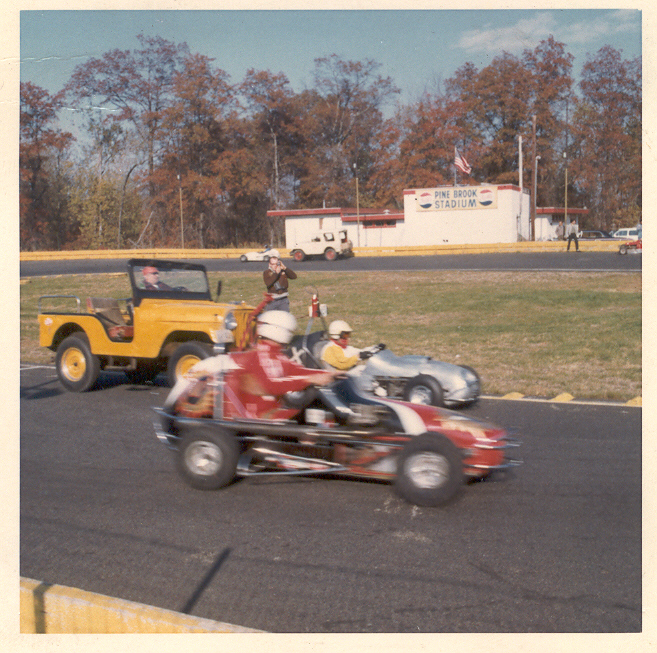
A puzzle this week, in a 45-year-old snapshot:

This Instamatic photo – remember Instamatic cameras? – was taken on a Sunday afternoon in October, 1967, at Pine Brook. The occasion was a racing program for the benefit of Norm Smizer, who had recently lost his eyesight due to complications from cataract surgery.

This photo was intended to be a clear shot of the silver car in front of the Mountain Garage Jeep, but the #0 whizzed into the frame as the shutter was opened. (Hey, what can you expect from a kid with an Instamatic?)

The puzzle concerns the silver car. It was brand-new that day, unpainted, with a masking-tape "X" for a number. But it did not fire and it did not race. Most significantly, and why we are interested all these years later, it was front wheel drive.

We cannot recall anything else about it. Who built it? Who owned it? Who was the driver on this day? What became of it? As far as we can remember, a front wheel drive car never again appeared after this day.

Was it squirreled away somewhere? Was it converted to a conventional rear wheel drive car, painted, and raced?

If you know the answers to any of these questions, or even if you have only a good guess, let us know via this link.

Oh, and if you want to confirm for us who the driver in the #0 was on this day, we’ll happily take that, too!

Wednesday, October 3, 2012

I Like Ike


Dwight Eisenhower was in the White House, and Gordon Eisenhower was on his way to victory in this photo taken on July 25, 1959, by Ace Lane, Sr.

We are posting this photo because the race was run on the fifth-mile infield track at Old Bridge, New Jersey, and Vintage Club members will have their cars on display this weekend as part of the annual Old Bridge Stadium Speedway Weekend.

It was a 20-lap feature that night more than 50 years ago, one of four late-summer ATQMRA dates at Old Bridge that year. Eisenhower qualified the Bob Pouleson 7o7 – the original 7o7, not the later roadster that many of us still remember – by winning the consolation race after failing to qualify through the heat races. Eisenhower took the lead on the twelfth lap and led Tex Enright and Jerry Wall under the checkered flag.

Today's drivers may not know what that lever is, outside the cockpit, on which Eisenhower has his left hand. That’s the brake lever, these cars did not have foot brakes. Also, down low alongside the cockpit is a nearly-vertical cylinder, which is the fuel pump. The fuel tank was pressurized by manually pumping this pump. Pressurized gas tanks... these cars were rolling bombs!

Eisenhower is wearing a loose-fitting uniform, likely not even remotely fire-resistant but certainly better than the T-shirts we see in many old racing photos. His goggles are hanging around his neck because – hard to see unless you click the photo to enlarge it – his helmet has a clear shield.

Eisenhower would win at Old Bridge again in August, again doing so by qualifying through the consi. Trailing Eisenhower to that second victory was George Sweeten, followed by Lloyd Mullin.