Thursday, July 18, 2024

Reunited, More Than 50 Years Later

 On June 22, 2024, former ATQMRA President John Little was reunited with the radical and championship-winning TQ that he and Jack Bertling built for the 1973 racing season.


Along with Harry Williams, Little and Bertling built the car in the garage seen in the background of the photo.  John Little and his wife, Pat, have lived in this house since 1958 (!) and are still going strong in their 90s.

With Bertling driving, the car won the 1973 series championship, and it won the ardor of Ray McCabe, who along with Joe Grandinetti restored the car over the past year.  The car had been found in Arizona, languishing and barely recognizable, and was brought back East by the late Bruce Kindberg.  Bruce was not able to undertake the restoration prior to his passing, so Ray and Joe picked up the ball and completed a faithful restoration.

When Ray and Joe brought the car to show it to John this past June, it made for a special moment because both John’s son and grandson were there to see the car as well.


(Click any of the photos for an enlarged view.)

Friday, November 23, 2018

A Champion, Indoors and Out


In this photo, driver Bobby Albert has just won an ATQMRA feature at the Islip Speedway in 1961. The flagger Johnny Zeke is on the left, in the middle is car owner John Dini and on the right is John's son Dick Dini.

In this car Albert would go on to win the 1961 ATQMRA championship, having already won the winter indoor championship driving for Bill Mildern.  (For many years, the ATQMRA offered separate outdoor and indoor championships, primarily because in those pre-Pine Brook days there were just as many indoor races as outdoor.). 

At the end of the 1961 season, John Dini sold this car to newly-retired Cleveland Indians pitcher Mike Garcia.  Garcia asked Albert to drive and maintain the car for the 1962 indoor season.  Garcia wanted Albert to race in indoor events at the Rochester War Memorial Auditorium and in Cleveland Ohio, which he did with success.  But the travel during the winter months, before the completion of the Interstate Highway system, got to be too much for Albert.  Vic Novell then offered Albert the ride in his #22 TQ for the remaining indoor season back east, so Albert gave the former Dini car back to Garcia.

Albert, who began racing in 1947, was a versatile driver who competed in Midgets, Sprint Cars and Stock Cars as well as TQs, winning a total of 109 feature races all together.  As a competitor in the always-tough American Racing Drivers Club series, Albert was voted Most Improved Driver in 1962, finished second in ARDC season-long points in 1965, and in 1969, driving the Strapoli Brothers Chevy II, he captured ARDC’s Stock Block championship.  He was the overall Super Midget Racing Club champion in 1974, driving a Buick-powered car entered by his son, Bobby Jr.

In 1980, driving in the United Racing Club Sprint Car series also in a car owned by Bobby Jr., Albert finished second to Paul Rochelle in driver points, and that was enough to earn the car owner championship for his son.

An intriguing footnote to Albert’s career is that he was the first driver to flip a car in a NASCAR race at the then-new Daytona International Speedway.  It occurred came one day before the first Daytona 500 in 1959.  The support race for the 500, the “Modified 200,” was comprised of Sportsman and Modified race cars, and for that first race Albert brought a 1937 Ford Coupe Modified to Florida from his home in the New York City suburbs.

The field was a whopping 55 cars, mainly consisting of coupes from the 1930s, like Albert’s. After qualifying 16th, Albert’s engine blew on lap three of the race while traveling 130 mph on the high-banked track. With oil on his tires, Albert spun in turn one. As the car hit the apron, it began to roll side-over-side, flipping several times before coming to a stop on the apron. Albert climbed out of the car unhurt and was credited with a 46th-place finish.

[Our thanks to Bobby Albert, Jr., for providing the photograph and much of the information here.]

Wednesday, August 20, 2014

New Old Photo


A nice shot of the Vintage Club pit area at Borgers Speedway in 2014.  It looks just like any pit area of 40 years earlier.  (Click the photo for an enlarged view.)

Tuesday, July 29, 2014

The Longest Track


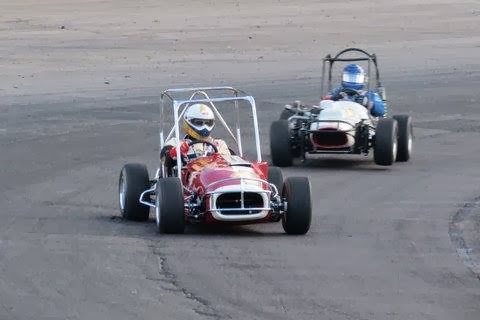
Here the Vintage TQs are on the track at Wall Stadium this past Saturday.

Wall Stadium is "the longest track" in a couple of ways.  First, for decades it was the largest track on which the ATQMRA raced.  Second, and more importantly in this context, it is the track on which the ATQMRA has raced the longest.  The TQs began racing at Wall Stadium in the 1950s and have raced there every year since.

Tuesday, July 1, 2014

Countless Race Victories


We don't have anywhere near enough fingers and toes to add up the number of racing victories represented by this group, photographed at a Vintage Club event at Bethel Motor Speedway.

The occasion included a tribute to Jim Maguire, which is why he is holding the plaque.

Bethel Motor Speedway is relatively close to the site of Max Yasgur's farm, where in 1969 the famous Woodstock festival took place.  Some of these guys were racing that weekend!

Thursday, April 10, 2014

Not Quite 75 Cents


What’s this?

It is the remnants of one of the ATQMRA’s most successful cars, the Zrinski “Six Bits,” the Crosley-powered #75 driven to multiple race victories by Jack Duffy.

Included among those victories was the one-and-only automobile race run inside New York City’s Madison Square Garden more than 40 years ago.

It is now in the hands of Lou Zrinski once again, and Lou is undertaking a full restoration.  (Click the photo for an enlarged view.)  Jack has his helmet bag ready!

An interesting sidebar to this story is that Jack Duffy was the only driver this car ever had.  In the years when the driver was one of the parts most often changed in a race car, the relationship between car owner Zrinski and driver Duffy was solid.

Here is another shot of the car, with Duffy at the wheel, taken after a feature race win at the Freeport Stadium in 1975:


Tuesday, February 11, 2014

A Stock Car?

What’s this doing here?


It’s here because the smiling young driver in victory lane at Freeport over 40 years ago vacated the seat in this street stock Camaro and began racing with the ATQMRA.  (Click the photo for an enlarged view.)

He’s Joe Schaefer, who got his start in racing at the wheel of this Camaro in 1974, driving for Fred Tuski.  The team had quite a year, winning eleven features that season.  Those of us in the ATQMRA witnessed most of those victories since the TQs were racing at Freeport on a regular basis.

It was obvious that Joe’s success was due both to the advantages of the light and nimble Camaro – most of the Freeport street stocks were mid-size and full-size cars – and to his smoothness at the wheel.  Clearly, Joe had the knack.

But at the end of the year the track management – Don and Gino Campi at the time – told Joe that he could no longer race in the street stock class, that he was required to move up.  Problem was, he did not have the money necessary to advance, so he and Fred instead purchased the #18 TQ from Pete Petraitis.

They repainted the car white and burgundy and re-numbered it X-1.

Joe started the 1975 season in the ATQMRA but soon landed a Late Model ride, so he only raced the TQ when time permitted. He  won the Late Model Race of Champions qualifier that year so he headed back to the stock car world.  He later drove Modifieds for Lou Timolat, a former midget driver himself and helicopter traffic pilot for WCBS radio in New York, until injuries ended Joe’s racing career in 1983.

During the time that Joe had the TQ he raced it at the Long Island tracks as well as a time or two on the dirt at Grandview and an occasional trip to Pine Brook.

Joe Schaefer went on to become President of Konig American, and he contacted us to help fill in any blanks in the history of the race car, which is now restored as the #18 and participating with the Vintage Club.

Monday, January 13, 2014

42 Years Later

A few minutes before the doors opened for the annual Motorsports show in the Greater Philadelphia Expo Center in January of 2014, the freshly-restored Barclay #93 stands ready in the ATQMRA booth.

The car was looking extra-sharp and attracted plenty of attention during the weekend-long exhibit.

The ATQMRA and the Vintage Club occupied a shared display space, calling attention to both the 2014 racing schedule of the modern TQs and to the activities of the Vintage Club.

Below is a photograph of this same car, at New Egypt Speedway 42 years earlier, with Jim Barclay up on the wheel.  (Click either photo for an enlarged view.)


Wednesday, December 4, 2013

Show Biz!


When the Tom Cruise movie Days of Thunder opened on June 27, 1990, Rich Tolerico’s Badger TQ was one of two race cars on display in the lobby of the Blue Star Cinema on Route 22 in Watchung, New Jersey. The other was Larry Brolsma’s stock car, which was far more appropriate for the film but since the theatre manager was a friend of the ATQMRA, a TQ got in the door too.  (Click the photo for an enlarged view.)

Before the movie began a drawing was held to give away tickets to an upcoming race at the Flemington Fairgrounds.  Pine Brook had closed the prior October, and Flemington would be gone in another 12 years.  Today the Blue Star Cinema isn't around, either.

Rich Tolerico remains active in TQ racing.

Days of Thunder, by the way, was a movie that got middling reviews at best but which was savaged by Chris Economaki, who gave it one-fifth of one star.  It is perhaps best remembered for this 18-second exchange between Robert Duvall, as the crew chief, and Cruise, as the driver.

Tuesday, November 26, 2013

Ed's Derby

We can draw a line from the Vintage Club presentations at the 2013 ATQMRA banquet to that year's “Turkey Derby” at Wall Stadium.  At the banquet a new award was presented in the memory of Ed Enes, and it was Ed Enes who got the ATQMRA on the November schedule at Wall.

The Turkey Derby began as a big year-end special for the Modifieds that raced weekly at Wall each summer, along with the support divisions that also raced weekly.  So it was a bit of a coup when Ed, as president of the ATQMRA in the 1970s, struck a deal with Jennie Nicol to add the TQs to the program.

The ATQMRA has been a part of the Turkey Derby ever since.

In this photo taken by Jim Smith at a pre-Derby practice session in 2013, then-new ATQMRA President Buddy Sload leads the TQs onto the track.


We need your vintage photos!  Help us keep the “Vintage Photo of the Week” going by sending us your pictures and information.  Use this email link – thank you!

Wednesday, November 13, 2013

Vintage Words

What follows is the text of Bob Marlow's opening remarks at the 2013 combined banquet of the ATQMRA and the ATQMRA Vintage Club:


The yearbook has a vintage TV Guide vibe to it this year.  But television can’t compare to racing.

In February, 1973, now almost 41 years ago, I accepted an invitation to go to the Can-Am sanctioned TQ races at the Daytona Memorial Stadium in Florida.  That invitation was extended by Alan Mollot and Ed Enes, about whom you’ll be hearing more later.  Alan and Ed had a state-of-the-art tow rig with which to take Alan’s race car to Florida.... Ed’s two-door Pontiac and Alan’s single-axle open trailer.  There was a toolbox in the trunk of the Pontiac.  What more do you need?

Well, there was a fuel crisis at the time so there was at least one if not more 5-gallon cans of gasoline in the trunk, too.

We left from Ed’s house in the Bronx during a snowstorm.

Why did I go on that trip?  Why not – if I had stayed at home, with snow falling, what would I do, watch television?  The top five TV shows at the time were All in the Family, Sanford and Son, Hawaii Five-O, Maude, and Bridget Loves Bernie.  Yep, Bridget Loves Bernie was a top-rated show.

Well, the week we were in Florida there was also The Mary Tyler Moore Show, Gunsmoke was still on the air, Ironside, Adam 12, or The Flip Wilson Show.  I could have watched Marcus Welby, M.D., The Waltons, The Carol Burnett Show, or even Monday Night Football with Howard Cosell and Dandy Don Meredith.

What wasn’t on TV in those days was racing.  The first start-to-finish Daytona 500 on television didn’t happen until 1979, the Indy 500 was shown on an edited tape-delay basis, and aside from the occasional race segment on ABC’s Wide World of Sports, there was virtually no racing on television.

The Partridge Family or Barnaby Jones weren’t going to keep me home when there was a race to go to, just slightly more than 1,000 miles from my home.  Alan, Ed and myself had a very memorable trip.  We wouldn’t remember a thing about any of those TV shows had we watched them.

Racing creates memories.  The Vintage Club is all about keeping those memories alive.

Wednesday, October 30, 2013

Chocolatetown

Every year we attend the annual Antique Automobile Club of America's Eastern Division Fall Meet, better known to old car enthusiasts simply as "Hershey."  We go every year, and every year we are saddened by the sight of the beautiful Hershey Stadium.  It's still a beautiful arena but today it no longer has the race track on which the ARDC midgets raced in the late 1960s and on which the ATQMRA raced in the early 1980s.

Today only the straightaways of the track remain, turns one and two having been eliminated in favor of a right-angle walkway, and turns three and four occupied by a large stage for concert performances.

The AACA uses the stadium for the race car demonstration runs that accompany the big gathering of the old-car faithful, but the cars can only tiptoe around the walkway and the stage.


In this photo from the ATQMRA races at Hershey now some 30 years ago, a remarkable seven cars are crammed into a small portion of the otherwise spacious Hershey track.  Click the photo for a larger view, and count cars.  There are eight if you include the tiny tiny piece of one just entering the frame from the right.

Ron Smith is the owner-driver about to test the roll cage on his #48, with two cars trying to occupy the same space beneath his car.  Ron's good friend Bern Bradley is exiting the scene in his own #32.  You guess is as good as mine as to who any of the others are.

Lest you think that no one showed up to watch these races, this photo was taken in turn two, and the seating area along the backstretch was not used for these races -- the fans sat on the frontstretch.  With 15,641 permanent seats in the stadium there was no need to open the bleachers along the backstretch.

Hershey Stadium (now officially called Hersheypark Stadium) is a great stadium that once held a great race track.


Friday, October 25, 2013

Bulldog Racer


Here’s Leigh Earnshaw, Jr., in Rex Green’s “Mack Special” in Atlantic City’s Convention Hall in 1969.  (Click the photo for an enlarged view.)

Earnshaw never made much of a splash in his limited appearances with the ATQMRA, but he most certainly made up for it when racing the ARDC midgets:  He became a four-time ARDC champion, winning the series title in 1973-74-75 and once more in 1980.  Earnshaw remains a highly respected member of the racing community today, some 30+ years after his retirement from competition.

Rex Green was known to everyone as “Doc,” because he was a physician and the company doctor at Mack Truck in Allentown, Pennsylvania – hence the “Mack Special” on his Crosley-powered car.  He was also one of the nicest gentlemen in racing, one of the guys who makes us miss "the good old days."

Wednesday, October 16, 2013

Antiques? No, Ahead of their Time

A substantial portion of the ATQMRA’s history is associated with the Crosley automobile engine, which was the dominant engine from the club’s founding and which remained in competition into the 1980s.  This, despite the Crosley automobile having last been produced in 1952.  Today the Crosleys are back on the track with the Vintage Club.

The Crosley was a tiny car, built in Indiana, and it sold in relatively small numbers.  Introduced in 1939, Crosley cars built before World War II were powered by two-cylinder Waukesha engines.  When Crosley automobile production resumed following the war, the Waukesha engines were gone, replaced by a remarkable overhead-cam inline four cylinder engine known as the CoBra.

“CoBra” was a contraction of “Copper Brazed,” because the engine block was fabricated from sheet metal!  The engine was developed during the war for military purposes, and served those purposes well, so Crosley adopted it for the cars beginning in 1946.  The block and cylinder head assembly weighed less than 15 pounds, and complete with all accessories (including the flywheel) the engines weighed only 133 pounds.  Displacement was 44 cubic inches (724 cc) and in original form the engines produced 26 hp at 5,200 rpm.  At the time this was the greatest horsepower output per pound of any engine.

In the military applications engine life was monitored by hours and careful maintenance schedules kept the sheet metal engines performing as designed.  But the postwar application in civilian automobiles led to corrosion problems for the engines, which damaged the reputation of Crosley cars.  For the 1949 model year, the engine was redesigned to incorporate a cast iron block assembly, nicknamed CIBA.


The Crosley CIBA Engine

Even with the change to a more traditional cast iron block assembly, the Crosley engine remained powerful for its weight, and soon became a popular choice in 750-cc class sports-car racing even before being adapted to TQ midgets.  Once the ATQMRA was founded, the cast-iron Crosley dominated the competition for 30 years.

If you’ve been following the timeline, your realize that this domination was accomplished by an engine that was in production only for the years 1949 through 1952, in a niche automobile that never sold in large numbers.  The engine’s longevity in racing is a testament to its remarkable design.

So, too, is the engine’s production life after Crosley automobiles were discontinued in 1952.  According to the experts in the Crosley Automobile Club, the rights to the engine changed hands a number of times, with Aerojet-General Tire, Fageol, Crofton, Homelite, and Fisher Pierce all owning the rights to the engine at one some point.  Each produced their own versions of the engine for a variety of uses, such as both inboard and outboard boat engines, refrigeration unit power sources, and for landscaping equipment.  Fisher Pierce, which marketed the engine as the Bearcat 55, discontinued it in 1972, some 20 years after the last Crosley car was built.

While there exist no specific records as to the last Crosley victory in an ATQMRA race, we can recall that the first ATQMRA race with no Crosleys in the field took place at the Freeport Stadium in the 1980s.  The Crosley had been displaced by the high-pitched two-cycle snowmobile engines that themselves dominated ATQMRA racing for 20 years.  The 2-strokes, smaller and lighter than the Crosley, were themselves displaced by the 750-cc motorcycle engines in use today.

1949 Crosley Wagon

1951 Crosley Hotshot

Monday, October 7, 2013

A Memorable Night


In this Dave Innes photo at Pine Brook on July 24, 1970, Phil Davoulas and the Bob Pouleson #7o7 are upside down against the backstretch fence at the far left as Bing Metz (33), Doug Craig (55), Frank Holz (41), and Joe Lacy (18) pass the accident scene.  Paul Weisel is facing the wrong way in Don Crabtree's #71, which had served at the launching pad for Davoulas.  Here’s the story, as told by Paul.  It’s a long story, but it captures the time perfectly.

Bob Wilkey and Larry Rice were graduates of the ATQMRA ranks, both moving on to the United Racing Club sprint cars by the late 1960s. With sprint car experience on their resumes, both also took occasional ARDC midget rides whenever their schedules permitted. Since I spent three seasons stooging for Bob Wilkey’s brother, Tom, on the ATQMRA tour, I was well acquainted with Bob Wilkey, his wife Mary, and their two children. Bob drove Dr. Rex Green’s #31 TQ and I got my first ATQMRA ride in Convention Hall in January of 1969 with Verona, NJ’s Willard McCumsey. Willie apparently bought Doc Green’s first TQ after a party following an Atlantic City indoor event in 1968, although neither Doc nor Willie could recall the details of the transaction. Those of you who attended those parties can understand how the details of minor events, i.e. the sale of a race car, could have been lost in the moment. When morning dawned Willie owned a race car and Doc was pleased his old car found a good home. With help from Karl Kindberg and John Fick, Willie’s #34 was ready for the first indoor race of the 1969 campaign and I was in the seat.

Larry Rice hailed from Little Falls, New Jersey, wore glasses, sported a crew cut, and was married with two children. My only personal experience with Larry came after Bob Wilkey won the July 27, 1968 Saturday afternoon URC event at the Delaware State Fair at Harrington driving for John Wergland. Everyone was heading to Reading for USAC sprint cars on Saturday night and there was no time to spare to make the start of the USAC program. Wergland led the procession towing his sprint car, Wilkey followed in the family sedan, and I brought up the rear in my Chevy. Larry decided he wanted to go along and since all the other vehicles were full, he hopped into the shotgun seat with me. Wergland took off, flying low, with Bob on his bumper. It was all I could do to keep up. Larry’s chatty disposition turned suddenly quiet as we began careening around the corners on US 13, heading north to Pennsylvania. Larry moved toward the passenger door and took a firm grip on the arm rest. He thanked me for the ride when we got to Reading, just as the sprinters were being pushed onto the track for warm-ups. He was never in need of another ride after that!

By 1968 roll cages were accepted on sprint cars running as supermodifieds all across the nation, including the iconic tracks comprising the central PA circuit. However, real sprint cars had roll bars, as did midgets and TQs. It was necessary to be 21 years of age to drive roll bar equipped open wheel race cars, regardless of their size. That’s exactly why I raced stock cars from 1966 to 1968, but I spent every free moment stooging for Tom Wilkey or just hanging around the open wheel pit areas. Open wheel clubs featured owners and drivers with very few men driving their own equipment. Sons of car owners carried on the family tradition and became car owners in their own right. At the end of the night, car owners paid their drivers. A core of veteran drivers served as the backbone of most open wheel clubs and they were quite content with the arrangement. Even after veteran Bert Brooks’ death in an ARDC event at Hershey on September 2, 1968, the ARDC membership voted against the use of roll cages for 1969.

On Thursday night, May 29, 1969, Bob Wilkey had a free night on his schedule and accepted a ride in Leigh Earnshaw, Sr.’s #51 Kurtis-Kraft Offy for the ARDC race at Reading. He was a racer on the rise and being offered the seat in a first-rate Offy midget was one of the perks of his career success to date. Bob started the main event outside the front row and drove hard into turn one, where he hooked a rut and barrel rolled the East End Garage Offy atop the outer concrete wall. Bob suffered a severe cerebral concussion and died of his injuries on June 3rd. From a somber waiting area in the Reading Hospital emergency room, I will always remember seeing a nurse cross the corridor with one of Bob’s boots in each hand. While Bob clung to life in Reading, I was off to run Willie’s TQ at Pine Brook the next night. I wasn’t alone, everyone else was there as well.

On June 15th, ARDC president, Ken Brenn, called for another vote on cages and the membership made cages optional for the remainder of the 1969 season. On July 3rd, during the running of the Bob Wilkey Memorial at Reading, Don Kreitz, Sr., driving a midget equipped with a cage, virtually duplicated the Wilkey crash in turn one and escaped with only a broken arm. Roll cages became mandatory in ARDC in 1970.

Larry Rice was between sprint car rides in 1969 when ARDC owner George Germond called him to drive his Offy midget at Islip, New York, on August 16th. Rice jumped at the offer. On the second lap of the scheduled 35-lap main event he tangled with Dutch Schaefer in Mike Sheehan’s Offy. In the melee, Schaefer’s car apparently struck Rice, rendering him unconscious before he crashed heavily into the outer guard rail. Rice was fatally injured, assistant starter, Dave Dannenberg, was struck and received a broken leg, and Schaefer was hospitalized in critical condition with a broken shoulder and pelvis.

So... kind of a long background to get to the Bob Wilkey / Larry Rice Memorial at Pine Brook in 1970. Although roll cages were mandatory in ARDC for 1970, they were not yet required in ATQMRA in 1970. No one seemed to mind as car counts were strong. Forty plus cars jammed the pits each Friday night at Pine Brook to battle for the sixteen starting spots in the feature. Cars were handicapped into four heats. Heat race qualifiers transferred to two semi-features with qualifiers from the semis going directly to the ‘A’ and non-qualifiers handicapped to the front of the ‘B’ Main. Non-qualifiers from the heats ran a consolation event with the qualifiers tagging the rear of the ‘B’ Main field. Qualifiers from the ‘B’ were added to the back of the ‘A’. It was no small trick to make the ‘A’ Main at Pine Brook in a field peppered with ARDC and URC veterans, plus the best from the Long Island and northern New Jersey stock car ranks.

The 1969 season was enough to retire Willie McCumsey from the owner ranks, but he will always be special in my book as my first open cockpit owner. I bought Ronnie Denman’s Crosley to run indoors in January and February of 1970, but I was always available to drive for someone else, especially someone else with a better race car. That someone in 1970 was Don Crabtree, a radiator shop entrepreneur from Caldwell, NJ. Don’s orange #71 wasn’t going to win any beauty contests, but his car’s Crosley engine was strong. On Friday, July 24th, we qualified in the heat, qualified in the semi, and started outside Bing Metz in the 35-lap ‘A’ Main honoring two guys I liked and respected.

Bing grabbed the lead at the green, but I was able to slip into second. A few laps into the event, Phil Davoulas in the Bob Pouleson Crosley powered roadster #7o7 motored around the outside of the #71 to take second. Veteran Jimmy Maguire had recently vacated Pouleson’s top-shelf ride to concentrate on the ARDC midget schedule for 1970. The roadster provided Jimmy with an opportunity to make an open wheel comeback from the loss of his right arm in a USAC sprint car crash at New Bremen, Ohio, on May 3, 1964. Jimmy regained his pre-injury form and became a contender in ARDC midgets for more than a decade.

As the event unfolded Doug Craig, Frank Holz, and Joe Lacy filed past on the outside, but we clicked off a lot of laps and when Nick Fornoro wiggled five fingers from the starter’s stand to signify five laps to go, we were solidly in sixth place. No one had gone by in quite a few laps and, aside from a few shots in the back bumper from the troops behind, things were looking pretty good. What I didn’t notice was, the guys who passed me earlier were now out of sight. What I couldn’t see was, I had eight cars, four rows two abreast, directly behind me and the leaders were now beginning to lap the tail enders. Pete Sindone, driving his own #40, had spent thirty laps trapped behind the #71, stuck in the lower groove I wasn’t giving up. With five to go, he ran out of patience, drove his bumper into my left rear, and spun the #71 exiting turn two.

I allowed the car to spin 180 degrees before I pulled the brake handle to prevent it from landing sideways in front of traffic. I knew there was a lot of traffic behind or I would have let the car spin to the infield, involving Sindone in his own mess. However, there were too many cars coming for that and Crabtree’s race car would have paid the price, so I decided to return the favor in an event to be determined. Who knows, maybe he had help? Things were going well until Sindone squirted to the inside and whoever was on the outside groove moved around on the high side. The second row also split me and the third row would apparently do the same, but there was a problem with the fourth row.

Phil Davoulas was leading the event and had moved between the final pair of cars in an effort to work his way through lapped traffic. Phil first noticed me when the third row split, but by then it was too late for him to miss the #71. When I saw Davoulas coming, I knew it was time to abandon the hand brake on the left side of the car. While lap belts were mandated, drivers of roll bar race cars never used shoulder harnesses because in a roll over you didn’t want to be held upright. With shoulder harnesses, YOU became the roll bar... not good! The idea was to bend in whatever direction was required and let the roll bar take the impact. We did, however, use Sam Brown belts which came around your waist and over your right shoulder and clipped into a steel chain or ring attached to the roll bar on the left side of the car. This setup was very effective for holding you in the car through left hand turns, but with Davoulas’ roadster bearing down, I needed to move RIGHT, something the Sam Brown belt would not permit.

By the time the #7o7 caromed over the front end of Crabtree’s #71, I had pulled my left hand into my chest and taken my right hand off the steering wheel. I’m told people under great stress see their life flash before their eyes – I saw Bob Pouleson’s roadster flash before me at eye level. Well, I saw at least half of Pouleson’s car before I turned my head to the right. I felt the #71 take slight contact before the #7o7 peeled off to the right in mid-flight like a WWII Corsair.

When all became quiet, Phil and the roadster were upside down against the outside fence, halfway down the Pine Brook backstretch. The left front tire on Crabtree’s car was flat and the hood was scuffed up a bit, but all my pieces were attached and working. As I took my goggles down and moved to the left to unhook my Sam Brown, I noticed a nasty tire mark about shoulder level on the left side of the roll bar on the #71. WOW! Six more inches toward the cockpit and Maguire and I could have been bookends! Twelve inches more toward the cockpit and, well, history would have been changed – for a lot of people!

Emergency crews were attending to Phil by the time Don Crabtree and his crew arrived. I exited the car, showed Don the tire mark on the roll bar, and helped them push the car to the pits. As we exited the track in turn two, Don asked me, “Are you all right?” Why do people ask race drivers if they’re “all right?” Good grief, we weren’t “all right” before we got into the car! I told Don that I was fine. That’s when he mentioned the tire mark on the left side of my helmet. When we got to the pits, I took off my helmet (open face – the only style available), admired Phil’s work, and put it in my helmet bag. Don wasn’t upset about the car, hell, we were running sixth in the main event, so we decided to run Pine Brook again the following Friday night. We continued together for the rest of the 1970 Pine Brook events.

I’m not sure Phil and I ever discussed the incident. We got along fine. It was unfortunate that Phil’s shot at winning the main event was lost, but he was aware I didn’t lose control of the #71, I was punted. He was uninjured. I was uninjured. Neither of the cars was seriously damaged. All in all, great fun!  After all these years, I have only one question about the incident. Phil, perhaps you can clarify? Did you hit me in the helmet with the left front or the left rear? In any case, nice piece of driving... or flying... or whatever combination of the two it was!

Note: If Paul’s face appears rather expressionless in the photo (click the photo for an enlarged view), it’s because he is wearing an unusual one-piece face shield that gave him the appearance of a robot or The Invisible Man.

Wednesday, October 2, 2013

On the Gas!


In this photo, Hank Rogers, Jr., leads drew Fornoro in Vintage Club races at Pennsylvania's Evergreen Speedway in 2013.  Yes, these vintage cars are raced.

Rogers went on to win this race and as you can see he is leaning on the car, it’s in a slight drift and he’s got just a little opposite lock dialed in.  Fornoro is hard after him, lifting the inside front just as Tony Romit did all those years ago.  (You don't think guys like Hank and Drew are just going to cruise around, do you?)

This particular race was for the four-cycle cars, and both of these machines are powered by Crosley engines.  A separate race for the two-strokes was captured by Tom Arntz, Jr.

Thursday, September 26, 2013

Viva Libre!


This photo from 1959 depicts one of the most famous races ever run, a race which many call the best race ever run.  Why is it here?  We’ll tell you after we tell you the story of the race.

In July of 1959 the Lime Rock Park road course in Connecticut staged what was termed a “Formula Libre” race, what is more colloquially referred to as “Run Whatcha Brung.”  A handsome purse was posted, and the event drew Ferraris, Maseratis, Corvettes, and Aston Martins, and included cars that had run and won in Formula One races.

Also there was the Kurtis-Kraft Midget shown in this photo.

The entry list contained a Who’s Who of drivers of the day, George Constantine, Pedro Rodriguez, John Fitch, Lance Reventlow and Chuck Daigh among them. 

And that year’s Indy 500 winner Rodger Ward, driving the Midget.

The day’s activities consisted of two 20-lap heats and a 60-lap main event.  Ward trailed in the first heat, but with a few changes to the car he managed to win the second heat by a comfortable margin.  Then the fun began.

In the 60-lapper – more than 90 miles on the twisty Lime Rock circuit – Ward kept himself in a position to win while the fuel load burned off, then, with 15 laps remaining, he turned up the wick.  He passed Daigh for the lead and won overall, thrilling the crowd and creating a racing story that quickly swept across the nation and the globe.

But why is this here?

Because active with the Vintage Club these days is Ken Brenn, the gentleman who owned the car driven by Ward on that historic day nearly 60 years ago.

Ken Brenn has a long list of accomplishments in racing, but one of his lesser-known contributions is that he is the contractor who paved Pine Brook Stadium in 1962.  Today Ken Brenn is a great supporter of vintage racing, from TQs to Indy Cars.  He is the man who, with Rodger Ward and a then-11-year-old car, did something in 1959 that today would be called “mind-blowing.”

Wednesday, September 18, 2013

Vintage Jim


In this photo from 1972, Jim Barclay in #93 hikes the left front while looking for room down low to stay ahead of Tony Romit, coming on strong in the upper groove at New Egypt.  Barclay was a consistent top runner, but at that time almost no one was a match for the combination of Romit and the Wehrle #02.

Today, both Romit and the Wehrles are gone but in 2013 Jim Barclay was very much with us and a supporter of the Vintage Club.  That’s him in the photo below, at Ken Brenn’s Warren Car Show in September of that year.


And car #93 is a part of the Vintage Club, too.  Having gone through at least two owners since Barclay sold it in the 1970s, in 2012 the car was reunited with the Barclay family.  Since the Wehrle #02 is also a part of the Vintage Club, today is is possible to see a re-enactment of the 1972 matchup on the track.

(As always, click either photo for an enlarged view.)

Monday, September 9, 2013

Under the Lights

A neat photo taken by Ed Smizer at a Vintage Club event at Oswego Speedway in 2013.  Those of us who have been around racing for decades understand the appeal of race cars under the lights as the sun sets and daylight fades...


Tuesday, August 27, 2013

A Classic at the Classic

It's "Classic Weekend" at Oswego Speedway this Friday-Saturday-Sunday [Posted 8/27/2013], and the Vintage Club will be there for exhibition laps on Saturday, August 31, along with the modern ATQMRA's big show and feature races for the Small Block Supers and the ISMA Supers.

Here's a photo taken by James Briery during last year's event.  (As always, you can click the photo for an enlarged view.)